Architecture.
What GlyphaeOS is made of, from the key you press to the pixels you see.
The compositor draws the screen
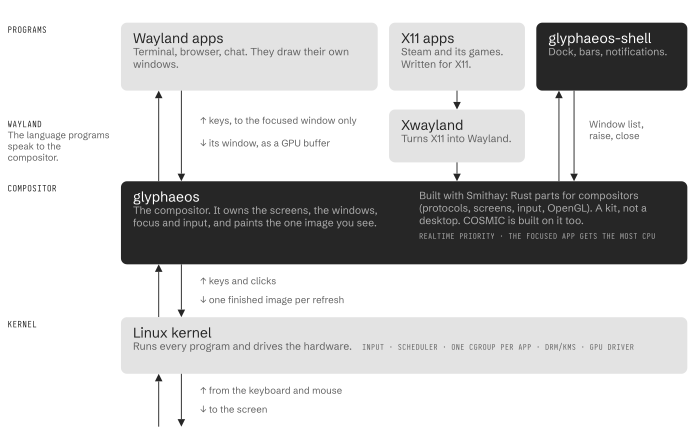
On Wayland there is no separate display server. One program owns the screens, the windows, focus and input, and paints the one image you see: the compositor. In GlyphaeOS it is called glyphaeos. When it waits, the whole screen waits, so it runs at realtime priority, the way the KDE and GNOME compositors do.
The app you are in comes first
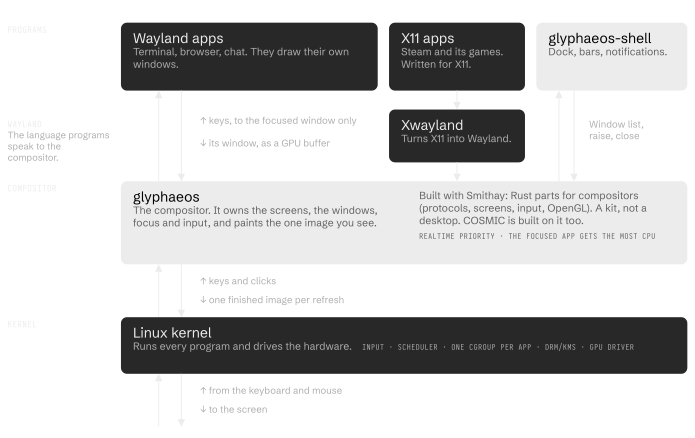
Every app GlyphaeOS starts gets its own cgroup, so the kernel shares the machine app by app. The compositor knows which window has your keyboard and tells the kernel: when the machine is busy, the focused app gets five times the CPU and disk time of any other.
Wayland and X11
Wayland is the language apps speak to the compositor. Each app draws its own window and hands it over as a GPU buffer. X11, from 1987, split that job between a server that drew and a window manager that placed. Apps still written for X11, such as Steam and its games, run through Xwayland, which translates for them.
Built with Smithay
The compositor is built with Smithay, a Rust library of compositor parts: Wayland protocols, screens, input and OpenGL rendering. It is a kit, not a desktop. System76’s COSMIC is built on it too.
The shell
The dock, the bars and the notifications are a separate program, glyphaeos-shell. It can restart in under a second without moving a window.
The same layers elsewhere
| Desktop | Compositor | Shell |
|---|---|---|
| macOS | WindowServer | Dock, Finder |
| Windows | DWM | Explorer |
| KDE Plasma | KWin | plasmashell |
| GNOME | Mutter | gnome-shell |
| COSMIC | cosmic-comp, on Smithay | cosmic-panel |
| GlyphaeOS | glyphaeos, on Smithay | glyphaeos-shell |